 HOW?
HOW?
Please complete the short survey via the link below or you can complete a paper copy.
https://forms.office.com/g/RFNCQZu6YL
WHAT?
We are currently working to identify and catalog all service lines, including those in your home. To limit costs and disruption to residents, we need your help identifying your home’s service line, which connects your residence to the main water distribution pipes.
If you have any questions or concerns, please contact The Village of Covington or Ohio EPA Lead.
The Village of Covington is below the Lead and Copper EPA standards through the village chemical testing. The Village of Covington does NOT have concerns at this time of Lead and Copper. The survey above is requirement of Ohio EPA to help identify service line inventories in the community.
What is a service line inventory?
A service line inventory is an EPA-mandated requirement for every water system to compile a list of all service line materials going from the water main into the building, as part of EPA’s new Lead and Copper Rule (LCR). Each community is responsible for collecting this data.
This federal requirement is aimed at enhancing the safety and reliability of our water infrastructure. It is part of our commitment to ensuring the highest standards in water quality and compliance with national regulations.
How do I find my service line?
Your service line is typically located near your water main shut-off valve. This is often found in your basement, crawl space, or garage.
- If your meter is in the house, the service line will directly connect to the meter before being distributed through your home.
How do I determine my service line material type?
There are various at home tests you can complete to assist with determining your material type. Your service line is likely made of either copper, galvanized steel, plastic, or lead. Try to locate where your service line comes into your house/business and perform these simple tests to determine your service line material.
- Plastic pipes are often black or blue and easily recognizable.
- If a magnet sticks to the pipe, it is likely galvanized steel as lead and copper are not magnetic.
- Another option is to complete a “scratch test” with a screwdriver and create a small scratch on the service line. If the scratch is shiny and copper in color (like a new penny, orange in color), your line is made of copper.
- If it scratches easily and the scratch is shiny and silver, your line is made of lead.
Why was a survey sent to me?
You were sent a survey to help verify the material type of the service line coming into the basement or crawl space of your home or business so that the water system can compile an inventory of all service line materials within the distribution community.
All Village of Covington residents and business owners who are charged for water use on their utility bill received the survey information.
Background: Lead and Copper
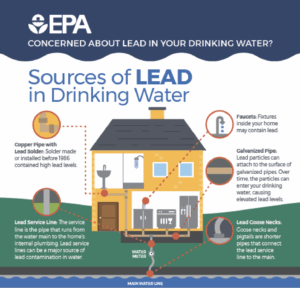
Lead and copper in drinking water is a topic of important national discussion. Lead has seen an increased amount of attention and oversight due to adverse health effects and issues other US cities have had concerning lead in drinking water. Lead can get into water as it sits or passes through internal plumbing systems or fixtures that contain lead. Older homes are more likely to have plumbing systems that contain lead. Which is why it is important for the Village of Covington to identify the service lines in the Village.
One potential for lead contamination of the water occurs when the service line between the water main at the street and the home contains lead. Although Ohio adopted a lead service line ban in late 1988, lead may also be present in the solder used on copper pipes before 1998, and in older brass fixtures. Until 2014, brass fixtures were allowed to contain up to 8% lead. Historically, lead was commonly used for water service lines due to its durability and pliability. While the Village of Covington water chemistry minimizes the leaching of lead into the water, when a service line is disturbed due to work being completed on or around the line, lead can be released into the water.
More information:
Basic information about lead in your drinking water.
https://www.epa.gov/ground-water-and-drinking-water/basic-information-about-lead-drinking-water
Protect your tap: A quick check for lead.
https://www.epa.gov/ground-water-and-drinking-water/protect-your-tap-quick-check-lead-0
List of Ohio EPA certified laboratories if you would like to test your drinking water:
https://epa.ohio.gov/divisions-and-offices/drinking-and-ground-waters/ddgw-programs/laboratory-certification
Below is a video from the EPA explaining the need to identify lead service lines and the impact for our community.